Wednesday, January 24, 2007

Dog Training Do's & Dont's


DONT'S

DON'T put your dog in a situation you or he are not prepared to handle.

DON'T turn a rude puppy or dog loose with an intolerant adult dog.

DON'T expect your dog to like every dog she meets (at least until you like every person you meet).

DON'T allow your dog to become over excited or rude -- help him find a more appropriate behavior or remove him briefly from the triggering situation.

DON'T allow other people to allow their dogs to be rude to your dog.

DON'T ignore your dog or what your dog tells you about her feelings.

DON'T punish a dog for reminding a puppy to mind his manners.

DON'T let your training or competition goals overwhelm your good sense -- always be fair to your dog.


DO'S

DO respect the fact that your dog has a need for and a right to protect her personal space.

DO socialize your dog so that he's wise in the ways of other dogs.

DO accept and expect the inexplicable disliking that your dog may have for another dog.

DO build your dog's tolerance levels through repeated, positive experiences.

DO continually educate yourself regarding normal and appropriate canine behavior in any given situation.

DO plan ahead to how you will handle difficult situations, people or dogs.

DO earn your dog's trust by keeping your promise to protect her.

DO pay attention to your dog when you are with him.

DO insist that your dog behave politely.

DO respect that your dog's individual needs may or may not be in line with your training or competition goals.

DO put your dog first -- all your hopes, dreams, titles and goals all mean nothing if you ignore the needs, fears and realities of who your dog is.

DO honor and respect your dog's concerns, whether or not you share them. (Remember how your mom left the light in the hall on at night when you were a kid? It probably wasn't because she was afraid of the dark.)

Winter Weeding AKA Purge to Socialization


I am in dead-of-winter-purge-the-extra-crap-out-of-my-life mode. And so I finally attacked a large dusty box of papers needing my attention (easier than the emotional crap that also needs weeding) -- would they live another season tucked in a file cabinet or go the way of the recycling fairies? And as I weeded through I found a few gems and thought to share. It also helps perpetuate avoiding another writing project hanging over my head. So, here, a hand out originally dated 11/2001 called....

Possible Reasons Why You Are Here and Things to Ponder Socialization

1. You're here at least in part to socialize your dog thoroughly with other dogs; for puppies, choose playmates of a similar age and adults who have been well socialized themselves. This means off-lead socialization, not sniffing noses at the end of the lead. The more experience a dog has with other dogs, the more refined his judgment will become about what constitutes rude or foolish behavior and how best to deal with it. He'll also learn how to be a polite dog himself.


If a dog has not or cannot be well socialized, be realistic about what you can expect from him in his dealings with other dogs. This may mean altering your training or goals to be fair to a dog who may not be able to cope with the stresses of more complex situations.

2. When socializing your dog under someone else's instruction or guidance, be careful. Some instructors and trainers are appallingly ignorant about basic behavior, and unable to set up a positive socialization situation. If you feel uncomfortable with a situation, remove your dog. It only takes a few seconds for a bad experience to leave a lasting impression, particularly on a young dog. I try to make this part of class fun, educational and supportive. If you have any questions regarding the socialization part of class, feel free to discuss.
Just turning dogs loose together to play is not socialization. There has to be supervision, and intervention when the potential for a problem appears. I will be paying attention to each individual dog as well as the pairings or subsets within the whole play group. If one dog is getting overly excited, we may take him out of the play group and calm him down before letting him play again. If a fearful dog has reached his limit, we may remove her from the group and give her time to relax and build her courage before putting her back in. If a particular dog or dogs begins to gang up on another dog, we'll break up the brat pack.

3. Watch your dog. Your dog will tell you all you need to know about his perception of the world. when you're with him, really be with him. Pay attention to his behavior. Position yourself and/or the dog so that the dog is always in your peripheral vision. Practice checking on your dog often. If he appears to be concerned, find out why. And then help him. Protect him. Teach yourself to recognize the small, subtle signs that he's shifted out of a perfectly relaxed state of mind. These may be as simple as the tilt of an ear, a raised eyebrow, a slight holding of the breath or tensing of the muscles. Each dog is different - learn to read your own dog.
If you can't watch your dog in a situation where there are potential problems, put him somewhere safe. I've seen far too many incidents occur unnecessarily because a handler was engrossed in a conversation and ignoring the dog at their side.
Handle your dog with awareness, not by the length of your lead. I always try to have at least 30% of my attention on my dog or dogs at all times when they are with me, if not more. During the class I expect at least 50% at all times.

4. Be proactive in protecting your dog out in the real world. If you see an ignorant dog owner and his rude dog headed your way, do your best to protect your dog. If possible, walk away, lightly and quietly asking your dog to come with you. Be sure you are breathing and relaxed -- don't let your apprehension about a possible altercation impact negatively on your dog. Dogs learn to be very sensitive to the sometimes subtle shifts of an owner/handler's mood.
If you can't walk away, try to get the ignorant dog owner to stop. Position yourself between the fool and your dog. If necessary, loudly and firmly tell the approaching person that your dog is not good with other dogs. If someone says this to you about their dog, respect it. In close quarters where there really aren't any options for moving away, shield your dog with your own body. (Remember, stepping between dogs is an act of protective leadership).
If you need to, sharply tell the fool to "please control your rude dog." You'll probably get a dirty look (fools rarely believe they or their dogs are rude and are shocked when spoken to sharply) but chances are good they'll at least make a show at controlling their dog or move huffily away from you.

5. Be aware of how your dog's social behavior will change over the course of the next month. Those of you with bouncy, rude dogs will see a calmer, more sophisticated play behavior. Those of your with shy, anxious, retiring type dogs will see a subtle or overt improvement in your dog's interest and ability to play. Those of you with more middle of the road type dogs will see relationships develop and increased communication skills. The degree to which the dogs will improve socially will help you to recognize the concept of measurable change. Enjoy the process. It's a lot of fun.


Thursday, January 11, 2007

New Year Aspirations


Welcome to a New Year!
Rather than becoming resolute about making resolutions I have decided instead to aspire to have aspirations as it seems much less stressful. And one of my aspirations is to reduce the level of stress in my life! In reducing this stress I don't even feel the least bit stressed about not getting to this until the 11th day of the new year. So far, so good.

I never went through a phase in my life where I said, "when I grow up I want to be a soft goods manufacturer" but lo and behold, having had the epiphany nearly 3 years ago to follow through on a great idea into a marketable product this is exactly what one part of my life has turned into.

My little idea of a no pull harness and backpack, aka Har-Vest, is mushrooming despite myself. From local to national and possibly beyond, I'm hoping to add to the resume of my life a successful venture in the marketing of what I truly believe to be an amazing product that I am proud to spawned! Keep posted in the coming months on news and if you happen to see anything out there in your travels...let me know with an email!

Friday, December 29, 2006

Out With Old In With New...sssshhhhh


As the year wanes we purge out the old -- decaying Christmas Trees, piles of collected trash, etc. -- in hopes that the new year will bring us health, happiness, hopefulness and good cheer. When ringing it in, don't forget that, like Independence Day Celebrations, loud noises of good cheer can scare your beloved dog(s). So take care, stay safe, and see you on the new datebook side soon.

Monday, October 30, 2006

Halloween & Dogs

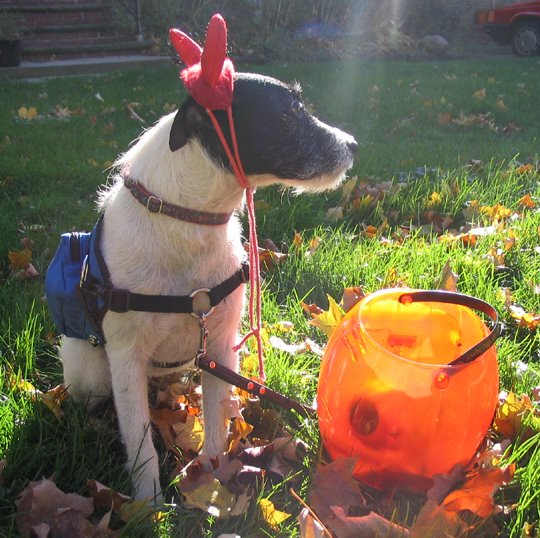
"Is the boogy man coming to take my pumpkin?"


"What's in those pumpkins over there?"


Halloween is around the corner. I know my kids are getting excited for that annual adventure of dressing up, knocking on doors and being given candy. They are finally at an age where they don't wonder why you can't just do that any ol' day and get candy.

Dogs are not as sophisticated at watching the calendar for the grand adventure of either going on the walk of all walks -- trick or treating or, for some dogs, the horror show of people endlessly parading up their walk in scary costumes, ringing the bell and yelling "TRICK OR TREAT". While it can be a wonderful socialization opportunity, for those who missed the boat or whose dogs find the stress too much to bear, management of the dog(s) away from the hordes is advisable.

After the treats have been accumulated (Trip and Bean collect them in the pockets of their Har-Vest), please be mindful of the possible toxicity of the treasures for your dogs and again, use wise management to keep eager noses and mouths away from the chocolates and candy.

Have a great holiday, and enjoy!

Sunday, October 29, 2006

Growing Up


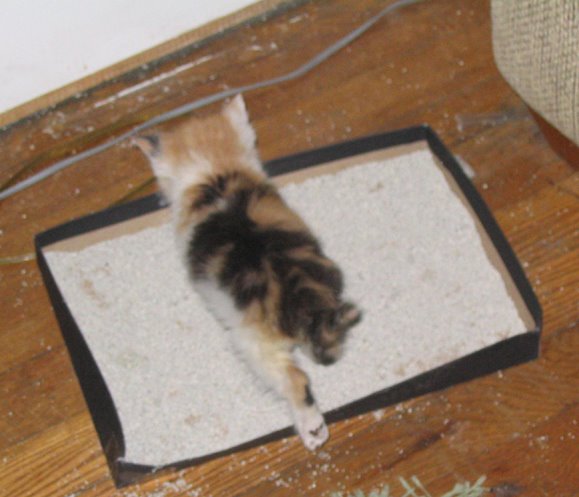
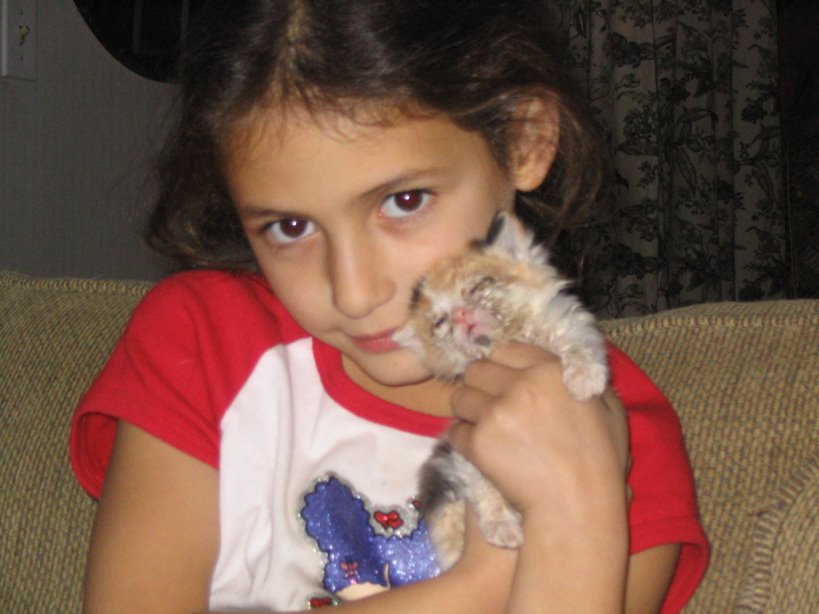
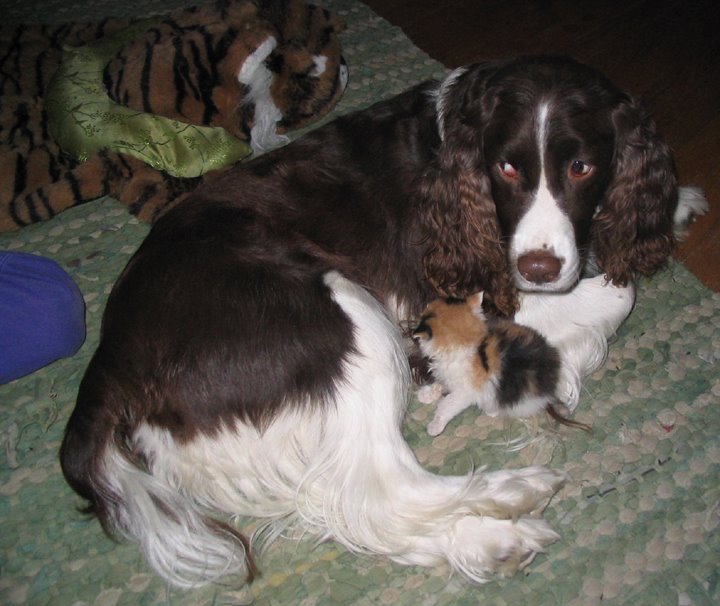
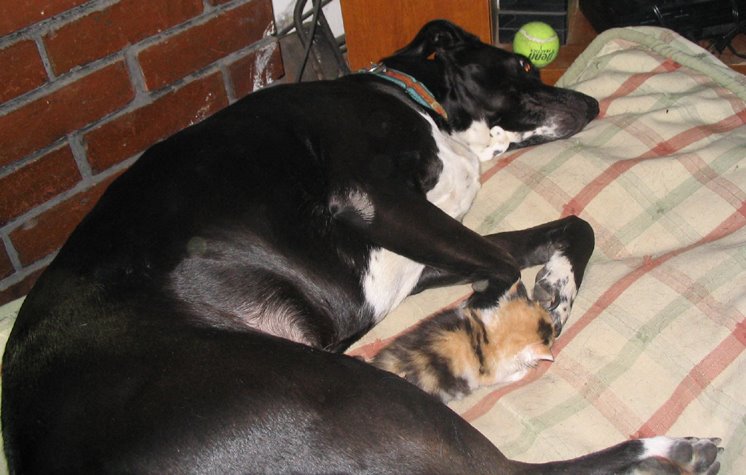
You care for them, feed them, help nurture them from helpless orphans and they start to take off on their own. Little Anna Heather, the orphaned kitten who came at the tender age of 3 weeks has been here almost half her life. From the scraggly little 6.1 oz critter she has gained more than a whopping 7 oz. and now is a footloose and frolicsome 14 oz. youngster. She has gained more sure footing, trots about fearlessly, eats solid food, uses a litter box, tries to clean herself (but still falls over more often than not), commanding the dogs to her bidding, winning the hearts of all who meet her. Needless to say I'm getting fond of her. But knowing I have to set limits, I have weeded through interested adopters and settled on a couple who live on my block. They will give her a loving and active home and the best part is should the kids and I want to see her, we'll be able to. The best of all words. I'm selfishly keeping her through Halloween to see what she'll think of trick and treaters and the pumpkins that will be flickering their orangey glow. Hopefully I'll be able to add updates on the little one over time.

Monday, October 16, 2006

Who's My Mama


As an ancillary part of dog training I often help with rescue efforts -- mostly to rehome unwanted dogs and cats, sometimes to help someone find a new dog or cat for their home. I'm often riddled with phone calls and emails asking me to take in an unwanted animal and most of the time I state that regrettably I cannot do that. I do have a petfinder site that has been very successful in finding homes for these animals, and because the results are usually so positive, I keep at it.

The other day my oldest daughter's best friend's father caught me in a vulnerable moment and I agreed to take an orphaned kitten off his hands with the caveat that he provide some kitten formula and a bottle.

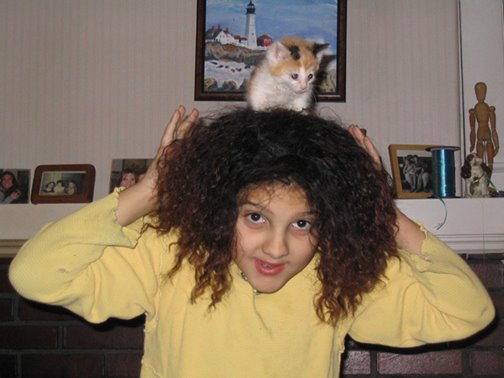
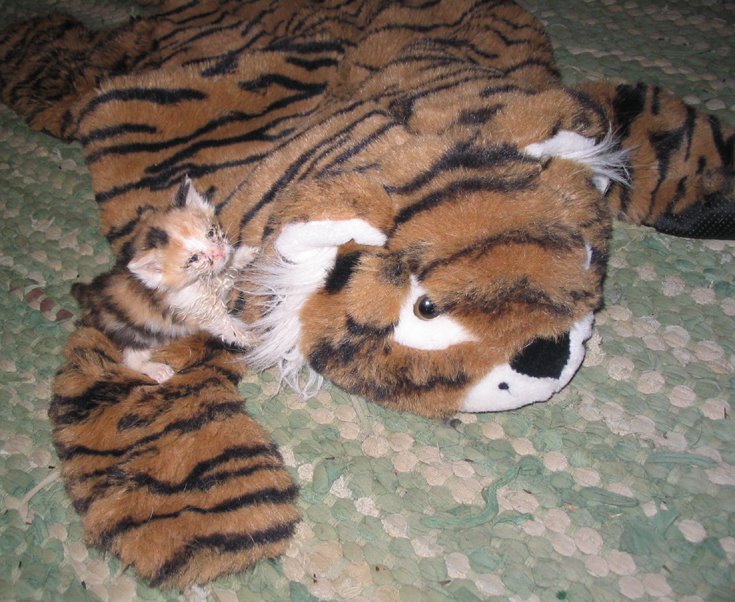
Anna Heather, aka AH, has been here nearly a week. She has thrived with regular round the clock bottle feedings and the gentle rubbing of her privates to stimulate her peeing and pooping needs, and she has grown from a scrawny 6 oz. to a whopping 9.1 oz as of this morning. She frolics around the house and seeks out any warm or potentially warm body as if to say, "are you my mama?"


Unfortunately, cats that are orphaned so young who don't benefit from the ministrations of a decent mother and the shared experiences of littermates often develop behavioral problems later on. We're hoping to offset that as much as possible by having her experience different people and animals who are gentle so she can minimize the emotional trauma of being wrenched away from her mother so young.

Tomorrow I estimate she'll be about 4 1/2 - 5 weeks old. We may crack open a can of kitten mush and see how she does. Unfortunately, I'm unwilling to wash her off with my tongue so frequent water based baths and quick drying efforts will hopeful make her look a little less scraggly over time!

We'll keep updates on how she does.
 
UA-4111843-1